Reading, watching and listening to everyday news of flooding or excess rain water accumulation on the streets of cities in India and many other countries has become very common. I wanted to reflect on this recurrent situation that the cities and the people therein face, through a personal experience I and my family, neighbours encountered in October 2020.
That night in October 2020
I particularly remember the date: 12th October 2020 when it rained excessively in Pune (or parts of Pune). Frankly, we did not realise the problem until sometime after nightfall when we peeped out of our windows to see all the 2-wheelers and some cars going under the water. We had two bikes- an Activa-I and Unicorn, both of them almost under water except for their handles. As I waded through the waters, and saw my neighbours doing the same, a realisation of this collective memory and loss etched my mind forever. It was not about the vehicles going down (yes that too but…) but more about the short time within which we came to have this experience. By 7-30 to 8-00pm, there was heavy rainfall but not so heavy to have such a situation in an hour. While, most of us with 2 wheelers were able to move them towards a safe place but that was not the case for car which by then, were completely submerged.
This was not the first time to experience a flood. I did it for first time in July 2005 when like Mumbai, suburban suburbs like Kalyan were also under water. Many of our friends had their houses filled with water, shops I frequently visited damaging extensively with flood water. That was my closest encounter with an urban flood. However, during that period me or my family did not directly get in way of the water and/or incur any damage.
Coming back to Pune, October 2020 event, the location of our society/apartment complex was next to a Nallah, one of the many Nallahs that move through the city of Pune, mostly reduced to channels which are heavily concretised. This particular Nallah travels a few hundred metres and meets the Mutha River near the Mhatre Bridge. It was evident that this Nallah had ‘overflowed’ and caused all this mayhem and memories of loss for many of the residents of the apartment complex. To be fair to the Nallah, the wall for our apartment was right next to it, thus giving it little ‘breathing space’ in case it gets some excess of water. But what was more important was this experience was akin to breaking of a dam, such was the intensity of flooding within a short duration.
Unlike many think, these Nallahs are natural drainages that are part of the watershed/s that constitute Pune city. With massive changes to land structures- especially the undulations and with heavy built up area, it is difficult to ‘find’ or experience a watershed that many Pune folks experience when they move some distance outside of Pune.
Pune has collective memory of Panshet Dam disaster, something that one can get to ‘feel’ by visiting a particular building on Kelkar road near Alka Talkies which depicts the water level when the dam had burst. It is quite high (at least 2 storeys) and one can only imagine the disaster that it would have been. But then, as memories play with us, such outlier experiences stay etched in the memory and the recurrent small incidences of ‘excess rainfall led flooding’ recedes to the background.
The next day some of us, while checking our respective vehicles for damage struck a conversation around the reasons for such a situation. We had only lived at the locality for 3 years by then, but those who had been there for 2-3 decades suggested they never experienced such an intensity of flooding. Some of us blamed the broken wall next to Nallah as the reasons or such an inundation. Others suggested choking of Nallahs as the reason. One of them pointed out to the STP constructed near the site of Nallah’s opening into the river as the reason. I realised that cannot be one singular reason that can be outlined for this disaster we experienced. Also, while we all were worried about our vehicles, I remembered our Mavshi who came from Dattawadi area where many habitations are right next to the river bed. The experience of damage or loss is so varied for various groups.
Of Nallah’s and heritage
Amitav Ghosh in his book The Great Derangement narrates the Tsunami experience on Andaman Islands and how senior military officials had their quarters/houses on the beach or sea front while how lower grade officials were living in the interior region of the island. Every time I visit Marine Drive, a place where I do not think I can afford a house in this lifetime, and out of that sadistic thinking, end up imagining what would happen to these high class, high end residences facing the sea if a disaster is to struck.
Many researchers have focused their work and discussion on the intermediate spaces dividing these larger forms. For eg. in case of seas, how tidal lines, in case of rivers, flood lines. They refer to these ‘amphibious spaces‘ and how they come to shape the relationships of the inhabitants in these cities and spaces and those water bodies. Some also point to the recognising cities as waterscapes and how colonial forms of governance demarcated these distinctions for effectively governing the colonised subjects and collect revenue on ‘land’ while also relegating the marginalised to sufferings of water woes.
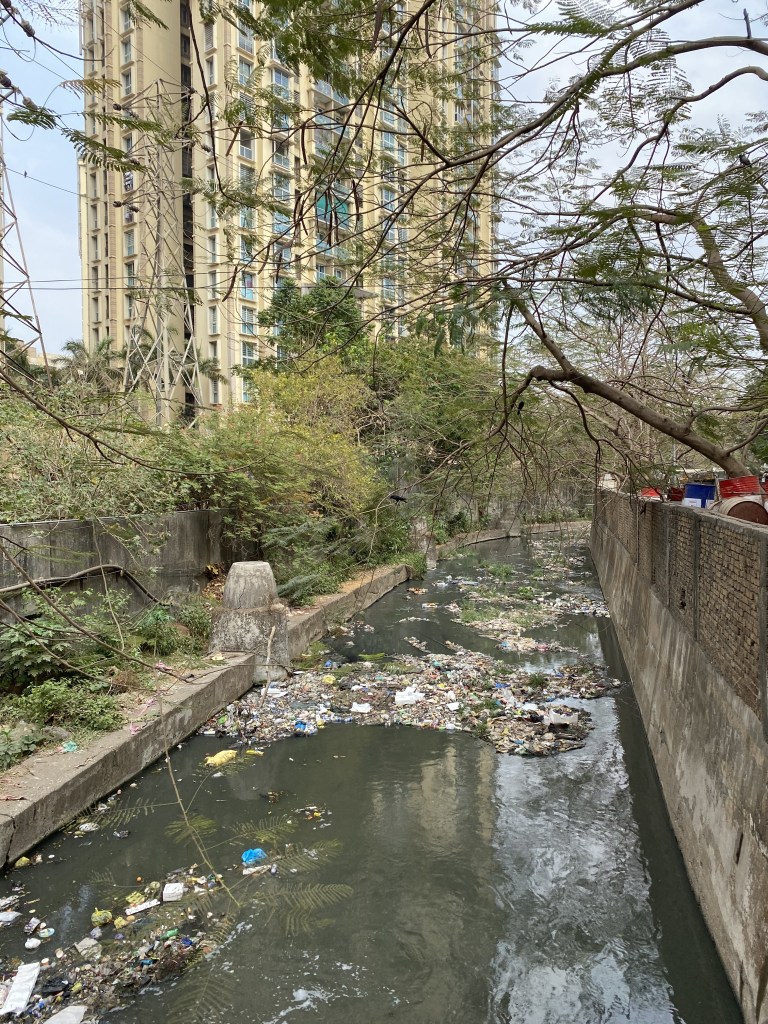
Unlike a river or sea, a nallah is a smaller form of water body that does not necessarily capture the imagination of those thinking about water. Look at literature for eg. How we conceptualise, romanticise, criticise our relationships with rivers and seas but often tend to neglect or relegate when it comes to such water spaces like Nallahs. These Nallahs have mostly being tampered with, reformed, reshaped through our interventions.
This was a criticism that an eminent hydrogeologist from Pune raised when he saw hundreds of meandering Nallah, streams, odha being straightened, deepened and tampered with under the Jal Yukt Shivar Abhiyan. A geologist by training, his heart yearned for tampering the ‘geological heritage’ that Deccan Basalts of Maharashtra (one of the largest volcanic province in the world), have given or formed in this region. That such short term, immediate interventions will eventually reshape the geography of the region going forward.
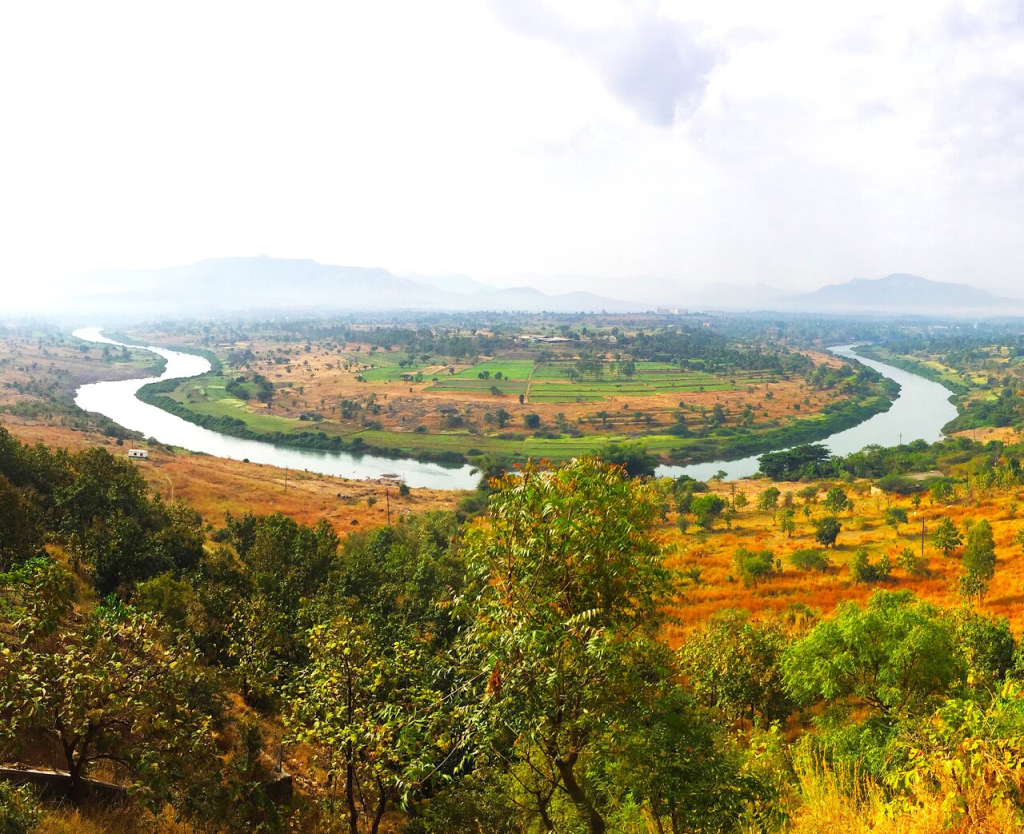
(Hydro)Geological heritage? What is that? If you may have watched the Marathi Movie Katyar Kaljat Ghusli there is a shot in the beginning that is from the famous Necklace point near Bhatgar Dam in Bhor taluka of Pune. Used as a setting for reflection or in between scenes, this is what can be meant as a hydrogeolgical heritage of Deccan Basalts. The rivers, streams have a ‘geological control’ which has shaped these forms and river ways. They are formed not as part of some scheme or 5 year plans, but in timescales that we may only attempt to imagine. There are also famous in other parts of the country (remember the Ken-Betwa region image). In identifying this heritage, we also value the agency of the non-human, in this case the rocks or the larger geology.
Valuing the non-human in uncertain times
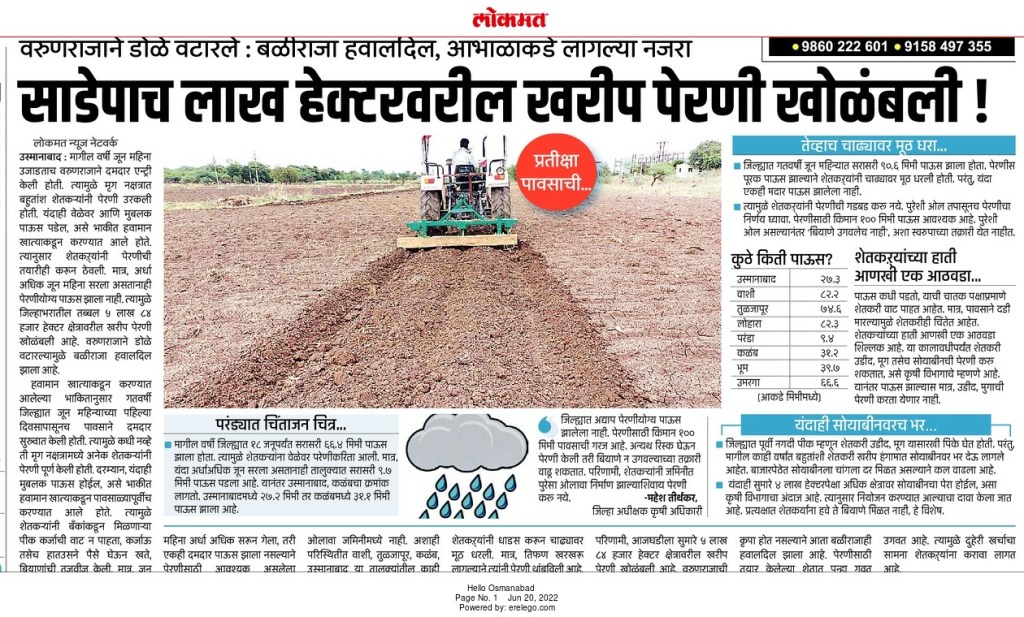
Look at these two contrasting news from last year from Osmanabad (Dharashiv) district. In June, there were news about lack of rainfall or delayed rainfall.
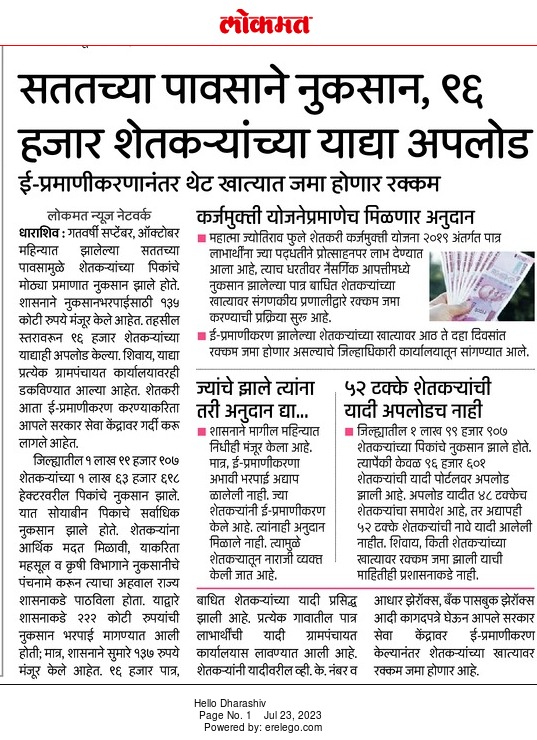
Now, look at this news. Many farmers have filled in application for damage/loss due to ‘continuous rainfall’. In villages, farmers were discussing what was termed as declaring an ‘Olaa dushkal’ (Wet drought). These contrasting news pieces also reflect the uncertain times that we live in, more than ever.
While, one may be able to identify the largely homogenous relationship between rainfall and the primary occupation in rural settings i.e. agriculture, the same is not the case in cities. Cities depend on rainfall but more importantly on the rainfall that falls in the catchment areas of the dams supplying water to them.
This has drastically changed over the last couple of decades, with ‘self supply’ becoming a predominant form of water supply situation in cities. Self supply can be deemed as ‘self arrangement’ something that is independent of the cities larger infrastructure or the ‘formal infrastructure’ as some like to quote it. What is the source of such ‘self supply’? In most cases, it is, yes, you guessed it wrong, it is not surface water. It is, groundwater.
Forget the metros, while groundwater forms key part of water supply in these cities, it is the tier 1,2 3 cities/towns that are now dependent on groundwater more that ever. Now if groundwater forms the key driver or urban development and sustenance then the rainfall in the catchment of the city, watershed of the city becomes equally important. And thus our relationship with that rainfall. Secondly, mapping and monitoring groundwater through a collective paradigm is equally crucial.
Pune’s aquifers
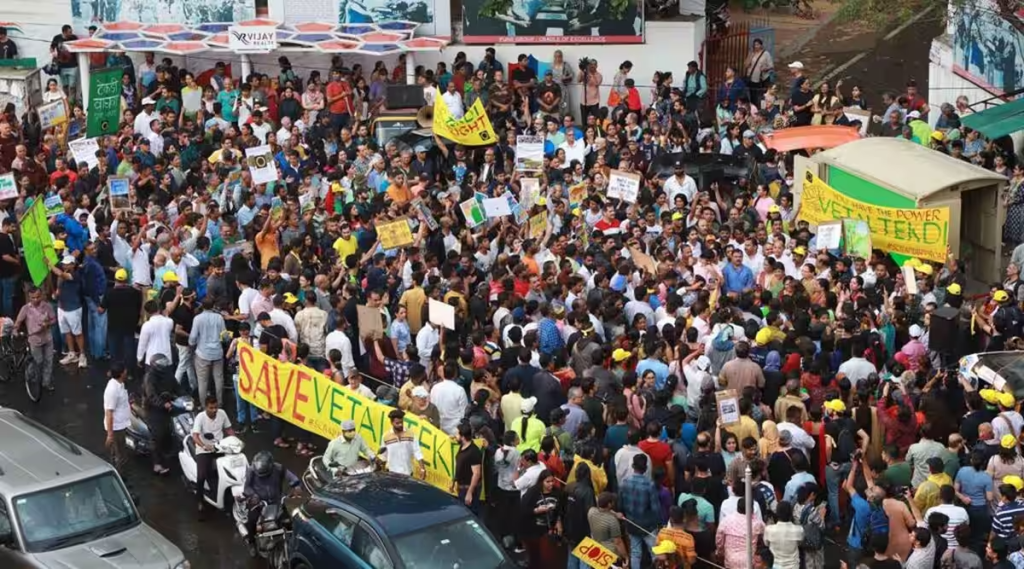
Due to some fantastic organisations in the city, and the rich social capital that the city rides on, thanks to a vibrant civil society engagement, we see, for the first time in our country, an opposition, protest building up against the ‘development as usual’ (road in this case) being challenged for conserving and protecting aquifers! Yes, I do not think there is any other instance where groundwater and groundwater systems like aquifers come to the forefront.
This gives us an opportunity as a citizen to value and actively engage in acknowledging the relationship between recharge-aquifers-groundwater-city that may, in time to come, enable policies and programmes that underlines these relationship. The NIUA has launched a pilot programme across 10 cities in the country attempting to map and understand groundwater. Partnering with some fantastic civil society organisations who have been working in this direction for quite some time, the project aims to engage with shallow aquifers in these cities. This is a start.
I believe attempting to engage with this other dimension of the city beyond simply appropriating it will go a long way forward. Any city, and Pune is no exception, with increasingly built-up areas loses a part of engagement with the subterranean/underground which is an important non-human agent in shaping water in the city. Acknowledging and valuing this relationship will shape our the future history of water in cities.

 Groundwater and Beyond
Leave a comment